Artist Information
Name: Geilman, Megan Knobloch
Location(s): United States
State or City: California, Utah
Gender: Female
Website: meganknoblochgeilman.com
Instagram: @megan.knobloch.geilman
Email: megan.geilman@gmail.com


by Megan Knobloch Geilman
Dated 2026
by Megan Knobloch Geilman
Moses 3
Digital composition
2026
Megan Knobloch Geilman, The Temerity of Eve, 2026. The Book of Mormon Art Catalog, [URL].
Name: Geilman, Megan Knobloch
Location(s): United States
State or City: California, Utah
Gender: Female
Website: meganknoblochgeilman.com
Instagram: @megan.knobloch.geilman
Email: megan.geilman@gmail.com
Figurative, Photography
Eve
apple
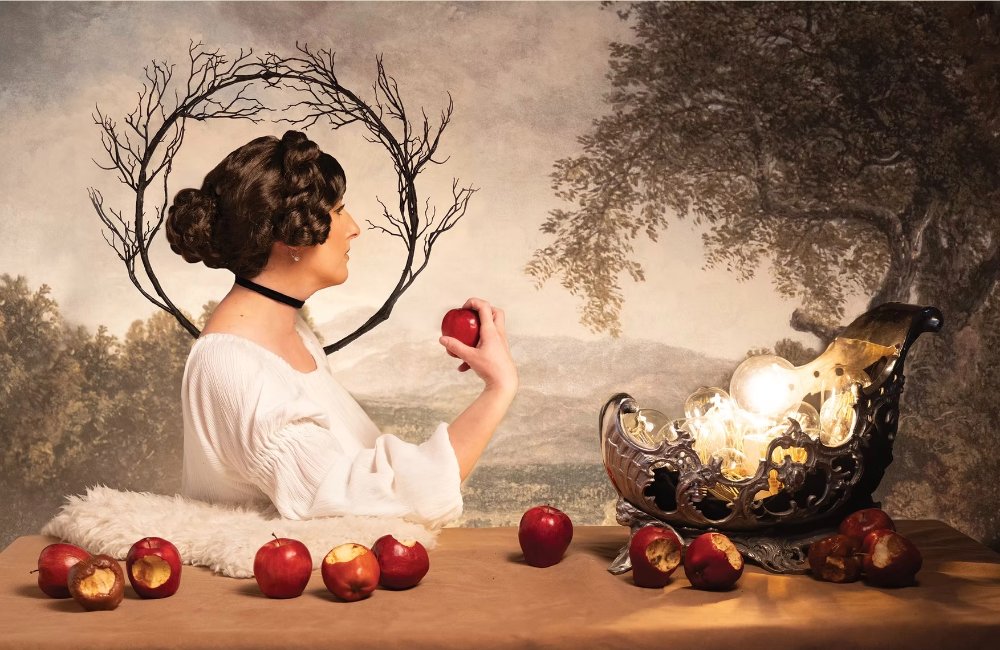
Artist statement: "The Temerity of Eve is a piece exploring female agency. I was greatly influenced by an article by scholar Catherine A. Brekus titled "Mormon Women and the Problem of Historical Agency." We were assigned this reading for Matt Bowman's "American Women in Christianity" class, along with work by scholars like Saba Mahmood and Laurel Thatcher Ulrich. At the same time I became intrigued with an image of Eve with more than one apple (which is a depiction I'd never seen before). She is always pictured with a singular fruit, signifying the great dramatic moment of the Fall, but what if it was many little choices? Brekus writes, "Given [the] implicit definitions of agency as freedom, empowerment, and intentionality, it is not surprising that the few women who appear in American religious history textbooks tend to be pioneering female leaders who self-consciously challenged the restrictions on their authority...Because historians have implicitly defined agency against structure, they have found it hard to imagine women who accepted religious structures as agents." These ideas combined in a paradoxical image of Eve as a polygamous wife, played by the artist, taking many bites of different apples. The apples are at varying degrees of decay, communicating a passage of time, a chronology to our choices. Few humans can be explained or boiled down to a single choice. The burnt halo represents the early charisma of Mormon women, often exhibited in healing blessings (a priesthood function that was eventually stripped away by the 1930s). The ship filled with lightbulbs conveys progression and knowledge. Despite the static nature of the image, it holds ideas of paradox, time, forward movement, and the beautiful mess of being human."
The Church of Jesus Christ of Latter-day Saints